Thursday, October 4, 2012

ASPENS IN COLOR IN SAN JUAN MOUNTAINS PART 1

  On Oct. 1 we drove up Ouray Co. road 5 from Ridgway to the base of Mt. Sneffels for nice views of the aspens and San Juan Mountains. Snow capped peaks added to the great scenery. These pictures were taken in my Canon A1100 IS 12 mp camera.

IMG_9817

The dry lake bed at the right is part of the Ridgway State Park where we are parked. Our destination for the day trip is at the foot of the mountains shown on the horizon.

IMG_9819

As we started up Ouray Co. road 5 ,other species of trees showed us that they were not going to be outdone by the aspens.

IMG_9827

As the road took us closer to the mountains they began to show the details of their ruggedness.

 IMG_9829

The road at the right in the valley probably is Dallas Creek Road.  The mosaic of color shows up nicely  here.

IMG_9834

A grove of aspens shares a common root system, yet all of the trees do not turn yellow uniformly.

IMG_9836

But this grove is of almost uniform color.

IMG_9838

Views like this are awesome!

IMG_9839

This is the view to the left of the last one.

IMG_9842

What a peaceful scene!


IMG_9849

And here are more multiple hues.

The road entered the Uncompahgre National Forest and continued for a few miles, but the aspens were less dramatic than those shown above, so we called it a day to return the way we came. A breeze then was causing yellow leaves to begin to drop. When we drove through the general area on Oct. 4 wind had blown leaves off all the aspens in many groves, moreso as we traveled farther south.

ASPENS IN COLOR IN SAN JUAN MOUNTAINS PART 2

On October 2 we picked up Jerry Wedlake (an elementary school classmate of mine in Beloit WI) at his Ridgway “cabin”, and after a trip to Subway for sandwiches, we headed up Owl Creek Pass road to the high country for spectacular color and mountain scenery. The John Wayne movie True Grit was filmed in Ridgway and in the vicinity of the Owl Creek Pass road.

The pictures speak for themselves, so I will not put captions on all of them.


IMG_9852

Cimarron Ridge is the backdrop for the fall color.

IMG_9853

This one shows some of the different colors of aspens in the fall.

IMG_9854

I think that this aspen gold color is now my favorite color1


IMG_9857

IMG_9856

More variable colors.

IMG_9858 

Here is a better view of the rugged Cimarron Ridge.

IMG_9860

We took the West Fork Road from the Owl Creek Road to explore the country, It deteriorated to an easy 4 wd road and we continued to the area where the road forded the West Fork of  the Cimarron River for our lunch stop. There is an occupied beaver pond to the left of this shot. The elevation here is about 11,000 ft.


IMG_9866

IMG_9869

After crossing the creek the road continued for a mile or so to a trailhead for those wanting to go farther by foot or horseback.

IMG_9873

A group of 5 ladies rode up here in a 2 door Wrangler and was having lunch at the trailhead. Jo is on the far right and Jerry is left of her.

IMG_9874

IMG_9875


SD530860

Chimney rock peeks through the foliage.

SD530877

SD530852

We were greeted with this view as we  returned from the high country.

On the horizon is part of the San Juan range, and Hy 550 is in the foreground.

Tuesday, September 25, 2012

ALFERD PACKER AND LAKE CITY CO DAY TRIP

On a  rainy day we traveled 50 miles south of our RV park on Blue Mesa Reservoir to visit Lake City deep in the San Juan mountains. It is a few miles east of Silverton via either Engineer or Cinnamon passes. The town was reached by a Denver & Rio Grande branch but the rails were torn out long ago.

One of Lake City’s dubious claims to fame is that the Alferd Packer cannibalism case began here. Mr. Packer has signed his first name both Alfred and Alferd, perhaps depending on his mood. Alfred is on this birth record, and Alferd was tattooed on his arm. I will use Alferd here.

He was born in 1842. In 1873 he agreed to guide 5 prospectors from Utah to Los Pintos Indian Agency in Colorado. Although warned by no less than Chief Ouray when his party was near Montrose CO not to enter the San Juan mountains in the winter, Alferd led them there anyway. They became lost near present day Lake City (which  not exist in 1874). The party experienced severe weather and ran out of supplies. Only Alferd Packer survived. In the spring the bodies of his companions were found, with signs of their having been murdered and eaten. Alferd was arrested and jailed in Saguache. Before he could be tried, he escaped and was on the loose for 9 years.

IMG_9802

Alferd’s first jury trial was in this courthouse in Lake City. It is the oldest courthouse in use in Colorado. The courtroom is on the second floor. He was convicted of 5 murders and sentenced to hang.


IMG_9798

This sign in the courthouse explains the story and has a time line of events of Alferd’s life.

IMG_9799

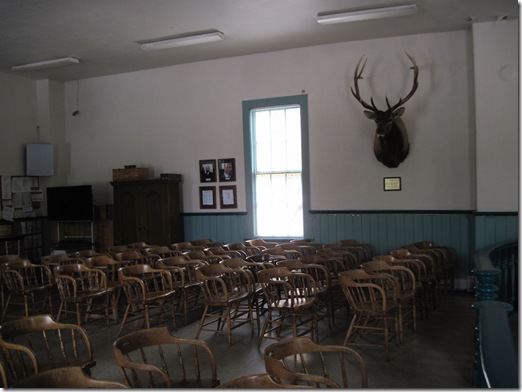
This is the courtroom in which Alferd was tried the first time. It is still in use.
IMG_9800

The courtroom had on display two nice Elk mounts (6 x 6).
 

IMG_9803

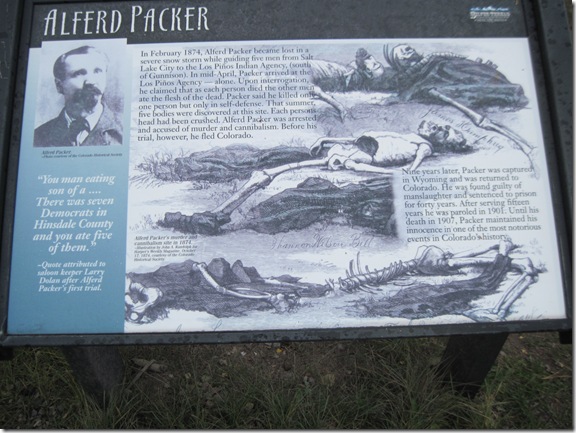
This account appears at the site of the “massacre”. Alferd’s death sentence was set aside on appeal, and upon retrial in 1886 in Gunnison after a change of venue, he again was convicted  but this time of 5 manslaughters and sentenced to 40 years at the Canon City penitentiary. After serving 15 years he was paroled in 1901 and lived in the Denver area until he died in 1907.

IMG_9804

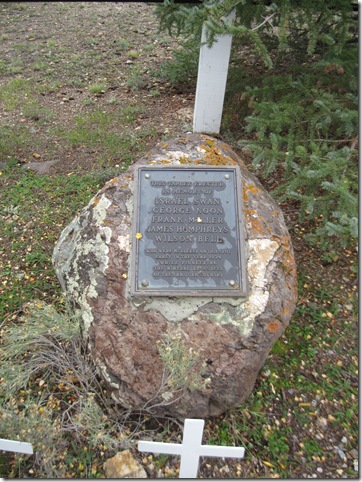
This is the memorial site at the place of the camp about 5 miles outside Lake City. The bones of all of the victims are buried here. They were studied by forensic anthropologists in 1989, and other studies were made in 1994 and 2000. They concluded that the bodies indeed were cannibalized and that they had died violent deaths.. There was some evidence to support Alferd’s defense that another member of the group killed the remaining members while Alferd was away from camp and that upon his return Alferd shot him in self defense.
IMG_9806

This plaque names the victims buried there.

Alferd is memorialized at the cafe on the University of Colorado campus in Boulder. It is named Alferd Packer Grill  - Have a Friend For Lunch. Another sign was in the grill for a while reading The Alferd Packer Memorial Grill with a motto: “Serve All Mankind”. Another account was that the motto was Serving All Mankind Since 1874.

A book is available on Amazon titled Alferd Packer’s Wilderness Cookbook in which the author goes into detail abut Alferd and gives a few recipes.


IMG_9807

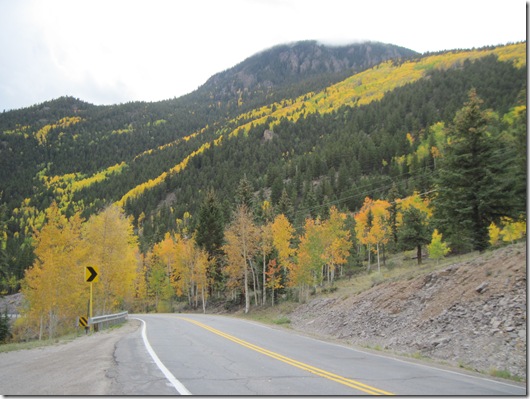
Fall colors were nearing their height around Lake City.

IMG_9808


IMG_9812

This store is a popular stop for 4 wheelers driving the Alpine Loop from Silverton over Engineer or Cinnamon passes to Lake City.


IMG_9814

How long has it been since you have seen a soda fountain like this? It is inside the store shown above.

IMG_9813

Yes, a bank actually does business in this quaint building.

IMG_9815

And here is a bar named for Alferd.

IMG_9816

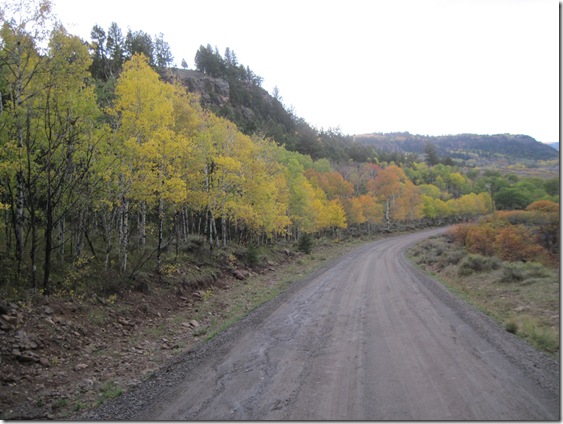
On the way back from Lake City we saw this area of changing colors ranging from green, to yellow green, to yellow, to nearly orange.

Monday, September 24, 2012

CUMBRES & TOLTEC SCENIC RR RIDE - ANTONITO TO OSIER (PART 1)

On Sept. 21 we rode the Cumbres & Toltec Scenic Railroad its entire length of 64 miles from Antonito CO to Chama NM, taking the bus back to Antonito. Riding the full length and bussing back was just $17 more than going to Osier and returning to Antonito.  I took over 50 pictures on the trip, and the following are the better ones. This  part covers the  trip up to the lunch stop at Osier. (Photos taken by Canon AS1100 IS  12 mp.)


 IMG_9730

Passengers are hurrying to board at the Antonito depot.  A group of French speaking people was aboard, with a translator for the Docent’s information.


IMG_9732

The first landmark from Antonito is Hangman’s Trestle, here obscured by discharge of contaminated boiler water from the blow down cock. The trestle accidentally was burned in filming a Willie Nelson movie made there in 1988 and was rebuilt a the expense of the movie producer. The first several miles from Antonito are through sagebrush, but the scenery gets better when the train gains altitude. Our train was pulled by a model K36 Baldwin engine built in 1925, no. 484. It and its sister engines numbered in the 480 series are the most-used engines on the railroad.


IMG_9734

The next landmark is Lava Tank. It was necessary when smaller locomotives with smaller tenders were used on the line. The larger engines used by the C&TS do not need to take on water there.


IMG_9738

Here our train is climbing up to the ridge on the horizon, taking the curve leading to Whiplash curve at the end of the next straightaway to the right. The roadbed near the top of the ridge can be made out just below the tall pine on the horizon. One of the pictures below was taken from the train on the upper track. The tall pine also is a landmark for nearby petroglyphs.

IMG_9739

Climbing up to Whiplash Curve


IMG_9741

Completing Whiplash Curve at the top of the ridge, we saw at Big Horn mountain on the horizon. The track goes past the base of the mountain where a wye is located.


IMG_9743

This is the curve  before the Whiplash Curve taken from the track barely visible in one of the above shots.


IMG_9745

Our first water stop was at the station Sublette, named for a Mountain Man. The building at the left is the bunkhouse for workers who maintained this section of the track, and the larger building is the section house for the station agent and his family.

IMG_9751

After Sublette, the train continued to climb. Here is the downstream end of the Toltec Gorge with nice color from turning aspens toward the left.

IMG_9752

We are entering Mud Tunnel, so named because of the loose material through which the tunnel was bored. It is completely lined by timbers.


IMG_9755

More color from turning aspens. The changing is just beginning here.

IMG_9756

Yet more color.


IMG_9759

And still more, with the Rio De Los Pinos in the foreground.

IMG_9760

Here we are nearing Osier and lunch!